
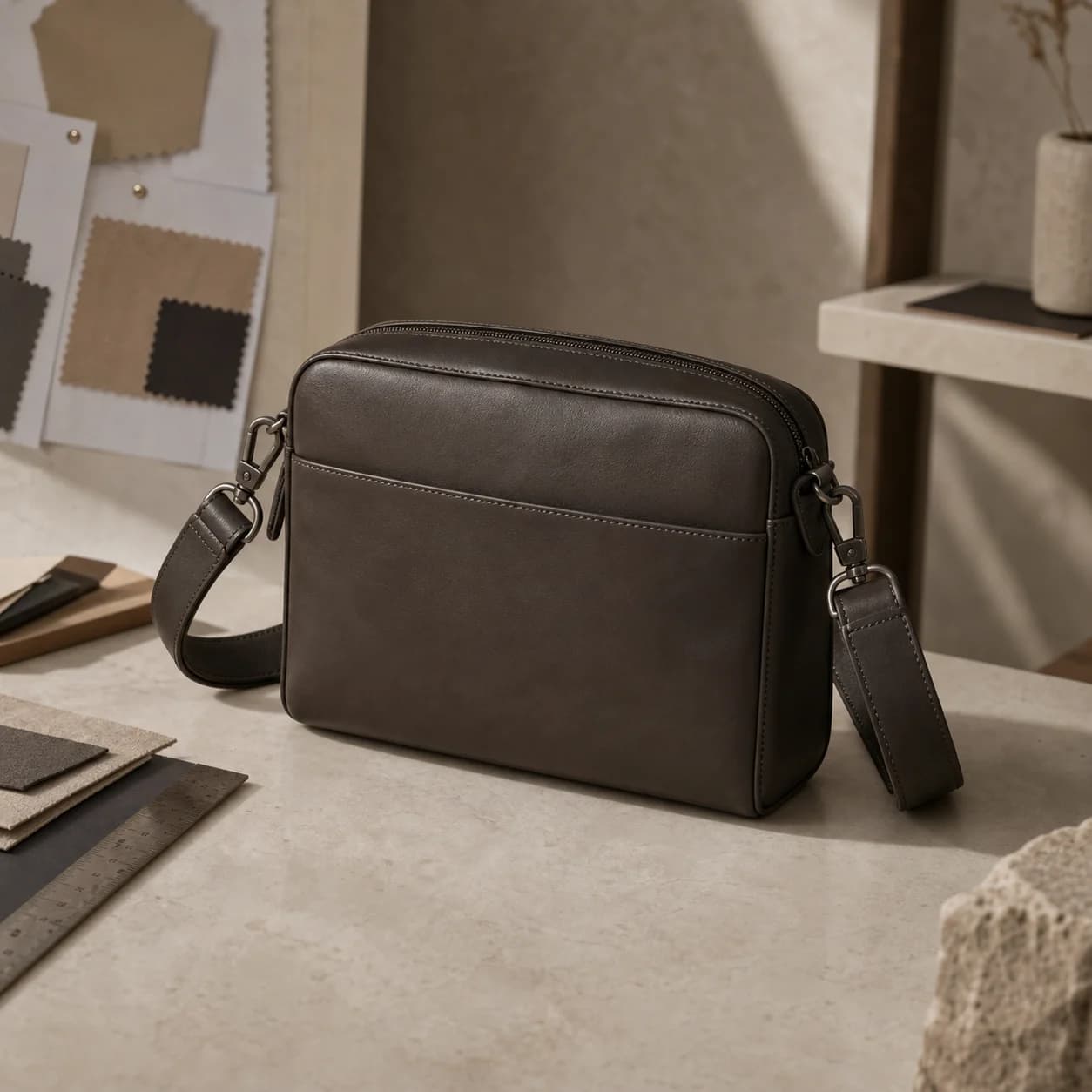
Prove That Each Carrying Mode Has a Job
A second carrying mode should solve a real situation, such as moving from a commute to a meeting. Adding hooks and straps only to make the specification look versatile can increase weight, cost and confusion.
Name the primary and secondary modes, the intended load and the moment when the customer changes between them.
Map the Load Path
Strap attachments, top handles and conversion hardware transfer force into the body. Their positions affect panel construction, reinforcement and the way the loaded product hangs.
A clean exterior rendering may hide the layers required around these points. Engineering review should identify those layers before the first sample.
Load-path review
- Top handle
- Shoulder straps
- Hooks and rings
- Base
- Device zone
- Opening
Test Access in Every Mode
A zipper that works on a table may become awkward while the product is worn. Pocket openings can also turn toward the body or become blocked by a folded strap.
Review access, security and hardware contact for each mode. The sample should be worn, converted and loaded rather than assessed only from still photographs.
Simplify Before Adding More Mechanisms
Remove any conversion feature that does not improve the intended journey. Fewer, better resolved parts often create a more convincing premium result.
The approved sample should document strap storage, hardware finishes, reinforcement, opening behaviour and loaded shape as part of the production reference.
Frequently asked questions
Can one bag convert into three or four modes?
It may be possible, but every mode adds complexity. The strongest brief usually prioritises a small number of genuinely useful configurations.
Can feasibility be confirmed from a rendering?
No. A rendering supports discussion, but load, comfort, conversion and access require a physical prototype.
Continue the development review with Recycled Fabrics, Convertible Daily Backpack, Material Lane Collection, Start Your Project.