Start With the Tote’s Real Use
Before deciding print scale, define what the tote needs to carry and how it will be used. A soft retail shopper, a structured work tote and a museum-store product may use similar artwork but require different materials, handles, openings and reinforcement.
A useful brief names the target customer, sales channel, typical contents, carrying method and desired level of structure. These decisions prevent the artwork from becoming the only design input.
Useful starting information
- Target market and channel
- Typical contents
- Soft or structured direction
- Opening and pocket needs
- Brand and packaging role
Prepare Artwork for Real Panels
A flat repeat does not automatically translate into a finished bag. Critical motifs can disappear into seam allowances, turn upside down on a side panel or be interrupted by handles and pocket openings.
Review the artwork against the actual panel map. Confirm repeat size, orientation, intended focal areas and acceptable variation. Customer-owned artwork and logo files should be supplied at a resolution and format suitable for the selected production route.
Panel review
- Front and back focal areas
- Side and base orientation
- Seam allowances
- Handle and pocket interference
- Small-accessory scaling
Review the Material and Print Response Together
Vegan leather bases differ in texture, coating, thickness, backing and fold behaviour. The same colour can appear different on two articles, and a surface that looks strong when flat may behave differently around edges or tight curves.
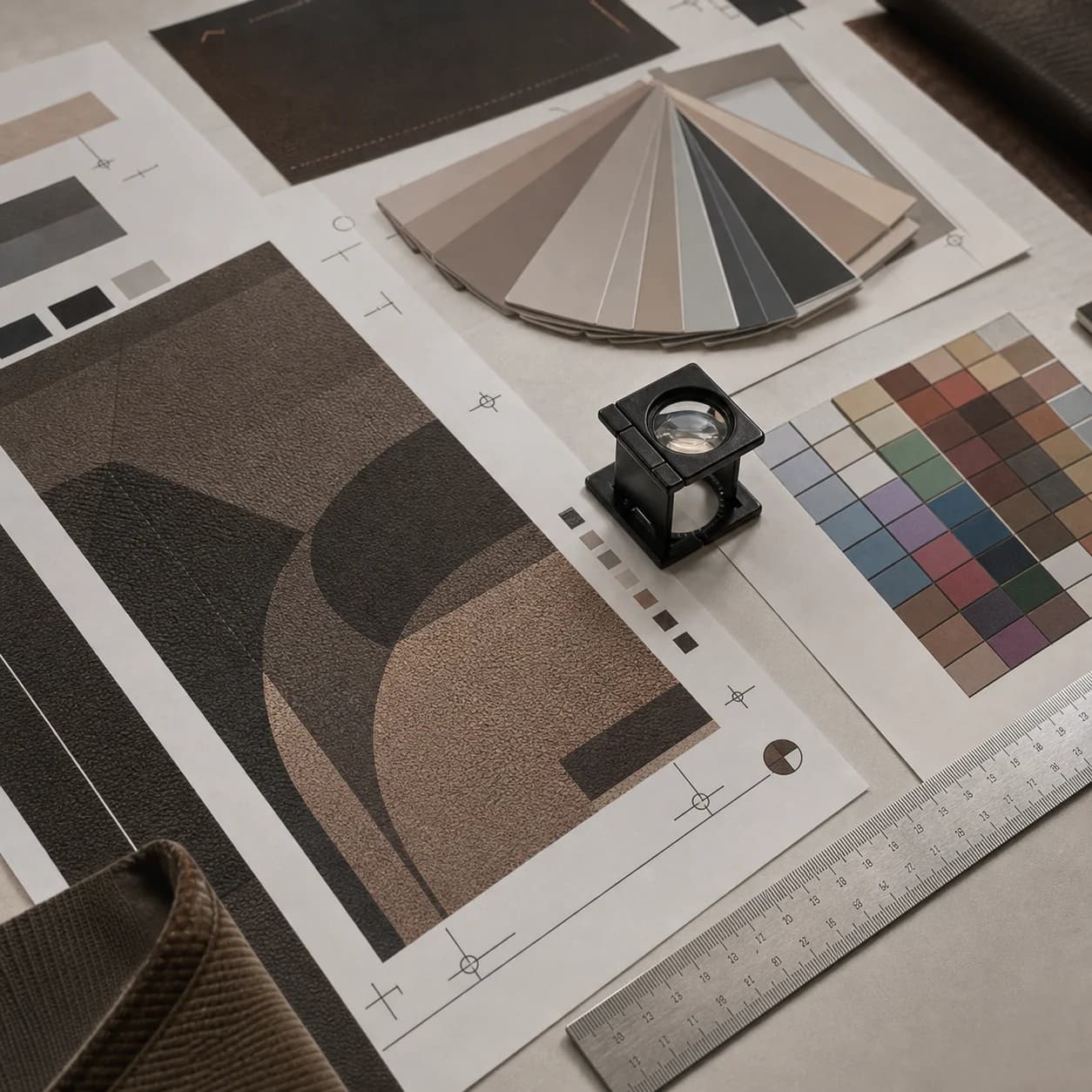
Use a physical proof to review colour, sharpness, hand feel and coating. If the product will receive regular abrasion, evaluate whether the selected surface and topcoat are appropriate for those areas.
Use the Prototype to Judge the Whole Product
The sample should be reviewed as a loaded product, not only as a photograph. Check handle comfort, opening access, interior organisation, panel alignment, edge finish and how the printed surface responds around construction points.
Record approved artwork placement, material reference, colour proof, components and packaging. This creates a clearer production reference and separates confirmed details from items that still need development.
Prototype checkpoints
- Loaded shape
- Handle comfort
- Opening
- Artwork alignment
- Corners and folds
- Lining
- Logo
- Packaging
Frequently asked questions
Can a screen colour be the production standard?
No. A screen is useful for communication, but a physical print proof or material sample should be approved.
Does printed vegan leather suit every tote structure?
No. The selected base, coating and thickness must be reviewed against folds, seams, reinforcement and intended use.
Continue the development review with Digital-Printed Vegan Leather, Printed Vegan Leather Tote, Material Lane Collection, Start Your Project.